- ! ! ! ! ! ! ! ! ! ! ! ! ! Latest Updates
- ! ! ! ! ! ! ! ! ! ! ! ! ! Latest Updates
- ! ! ! ! ! ! ! ! ! ! ! ! ! Latest Updates
- Home
- Boa constrictor subspecies
- Boa constrictor - Interesting Facts
- More boa information
- Boa Gallery
- Boas for Sale
- Contact

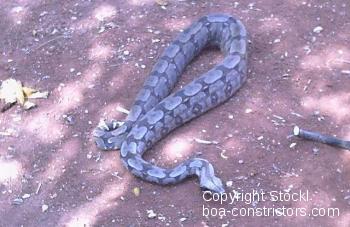
Boa c. amarali - crossbred and misbranded
Boa c. amarali crossbreeds | Boa c. Amarali mutts | Boa Constrictor Amarali crosses | purebred Boa c. amarali | True boa c. amarali | true short tail boas | true short-tailed boas | constrictor amarali crossbreeds
Boa c. amarali offspring for sale
The Brazilian Short Tail Boas occur in the savannahs of the state Sao Paolo and in the Pantanal, which is situated south of the Serra dos Parecis.
This central highland represents the southern perimeter of the Brazilian Amazon basin, the distribution area of Boa c. constrictor.
The Serra dos Parecis is a natural distribution barrier that can not be overcome by boas. It is due to this barrier that there are no intergrades of the two subspecies found in Brazil.
Because Sao Paolo is surrounded by a mountainous region towards the interior of the state, the distribution area of the Brazilian Short Tail Boas is divided. This is a natural barrier to the Pantanal. Thus the Boa c. amarali from the savannahs of the countryside of Sao Paolo are largely isolated from their relatives in the Pantanal.
This topografic map of Brazil shows that the Sao Paulo variant of Boa c. amarali is secluded from the Pantanal variant and the Boa constrictors farther north by a mountainous region. Also the Pantanal variant is isolated
by mountains from the Boa c. constrictor in the north.
Therefore it isn't possible that short-tail boas who look like the Sao Paulo variant occur in Bolivia, the more so as the entire Pantanal is situated in between these regions.
Because of the seclusion of the distribution areas it is also impossible that short-tail boas who look like Boa c. constrictor occur in the southern part of Brazil.
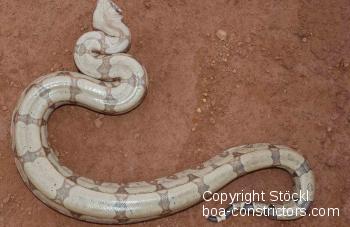
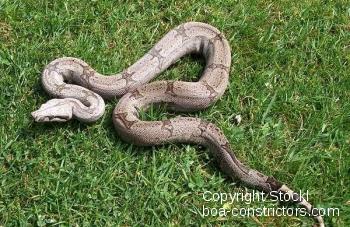
Bolivian Boa c. amarali, however, look similar to Boa c. c. in color and pattern (see the photo on the bottom of the page) because in this case there is no barrier to the distribution area of Boa c. constrictor.
The Brazilian Amaralis belong to the less colourful representatives of the Boa constrictors. In contrast to the Bolivian Short Tail Boas, they are quite different from Boa c. constrictor.
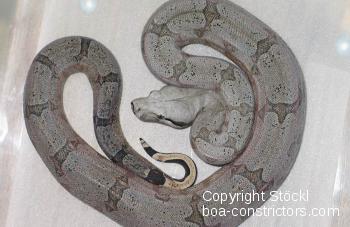
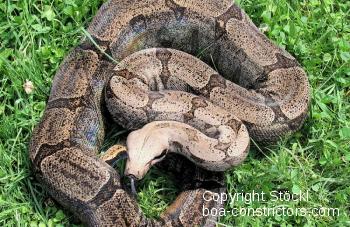
In fact, the Brazilian Amaral’s Boas from the Sao Paolo region are referred to as “silverbacks” in the European boa breeders and keepers community. This term was initially created in the U.S. and was at first used only to describe light grey (silver grey) specimens. In Europe, this term has been gradually applied to all Short Tail Boas from the Sao Paolo region, although most of these animals are either of a dark-grey or brownish colour, rather than silver-grey.
To the best of our knowledge, only the Sao Paolo form of the Brazilian Boa c. amarali is kept in captivity in Europe. For a long time the only European source for these animals had been in Denmark, creating the term “Danish bloodline“.
Brazilian Short Tail Boas from the state of Sao Paolo belong to the few forms of Boa constrictor that can actually be identified as representatives from a certain region just by their appearance.
These are the reasons:
1. The origin of the so-called „Danish Bloodline“ of Boa c. amarali from the region of Sao Paulo/Brazil is verified and their appearance frequently documented
2. The appearance of these boas is very distinctive and typical
3. In 2003 we were lucky to get one of the first legal exported farm bred Boa c. amarali from the region of São Paulo/Brazil. The imported short-tail boas are the spitting image to the specimens of the Danish bloodline. This proves that the boas in this region are not very variable in their appearance
1. US Boa c. amarali - Bolivia vs. Brazil
All the more it is surprising that on U.S. websites short-tailed boas whose appearance leaves no room for doubt that their ancestors stem from the region of Sao Paulo/Brazil are labeled as "Bolivian Amaralis".
We already began to have doubts about the classification made by the US keepers in 1999 and thus consulted Francis C. Vasquez, a well-known Bolivian herpetologist, to clear up this problem. In the scope of a conservation project performed with several colleagues, VASQUEZ had collected some 600 Boa c. amarali in various parts of Bolivia. For this reason, we considered him as a person to turn to whose competence exceeded that of the US keepers and breeders of Boa constrictor.
So we sent Vasquez photos of ‘silverbacks’ from the Danish bloodline and asked him for his comment. He answered that none of the Bolivian ‘Amaral’s’ had looked like the animals shown in those photos.
This is not astonishing if one considers that São Paulo and the Bolivian range of Boa c. amarali are more than 620 miles apart. Also, the frontier of the São Paulo region towards the interior is marked by a mountain range which constitutes a natural barrier against the more western distribution areas.
This begs the question of why the Brazilian Short Tail Boas from the Sao Paolo region are commonly referred to as Bolivian Amaralis in the U.S.
The answer to this question is found in the book "The Complete Boa constrictor" by Vincent Russo, in the chapter about the history of keeping Bolivian Boa c. amarali in the United States. According to that book, it is ASSUMED that the male who founded the stock of captive born Amaralis in the U.S. in 1986 was part of a shipment of approximately 40 animals who were being imported from Bolivia in 1982. It further states, that most of those imported specimens were dispersed in the pet trade. The classification of the U.S. short-tailed boas as Bolivian Boa c. amarali is therefore based on a mere ASSUMPTION.
2. US Boa c. amarali
The short-tail boa / red-tail boa crossbreeds
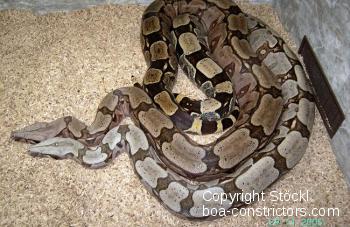
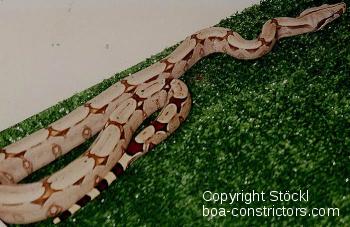
Of course, the question arises which snakes are presented as Brazilian Boa c. amarali by the US keepers if the ‘real’ animals are erroneously assigned to Bolivia. If you click to respective photos published on the internet, you usually see animals which show a pale ground coloration and bright red (!) tails. These snakes are labeled ‘South Brazilian Amarali’ although they differ slightly (or not at all) from Boa c. constrictor. In most cases, even their tails are much too long for short-tailed boas.
The bloodline bred by the late Lloyd Lemke (USA) enjoys an exceptional popularity. In the United States, these ‘Brazilian short-tailed boas’ have won considerable renown. Unfortunately, there is a catch to it: A classification based upon counting the dorsal scale rows (which was not performed by us but by US Boa constrictor experts Dennis Sargent and Jim Pomaville) has proved that these animals were actually Boa c. constrictor.
As you could read in the chapter dealing with Boa c. longicauda, we take a rather critical position towards the counting of scales and saddle patches because the respective standard values are usually based upon fairly small samples of analyzed specimens. Some of these specifications have already been refuted in practice.
In this case, however, we do not have the slightest reason to question the statements made by Sargent and Pomaville, as the occurrence of similar red-tailed snakes matching ‘Boa c. constrictor’ in midst of the range of Boa c. amarali would be as plausible as red-haired palefaces in a kraal of African nomads in the Congo region.
As a US insider has told us confidentially, several US breeders crossed ‘South American Amaralis’ (i.e. Boa c. constrictor) with pure-blooded Boa c. amarali some years ago. These practices partially resulted from a misjudgment to which those fellows adhere to the present, but it also aimed at a ‘face-lifting’ for the short-tailed boas which obviously suffered from a lack of color. Consequently, many crossbred snakes (Boa c. constrictor x Boa c. amarali) are now being marketed in the USA. Photos of the litters born by these animals show marvelous ‘red-tailed boas’ - partially with short and partially with long tails, depending on the predominance of the respective genetic make-up (Boa c. amarali vs. Boa c. constrictor). It is only fair to mention that there are also US keepers and breeders who have been pointing to the inaccuracies described in this chapter for many years. These fellows have a rough time in ‘The Land of the Free’ as the economic interests of important US dealers (who are not willing to give up their long-standing and profitable marketing practices) stand in the way of truth.
"The tails will give them away..."
Thus it is that in the US and due to imports also in Europe many Boa c. constrictor / Boa c. amarali crossbreeds are on the market. Photos of the litters born by these animals show marvelous ‘red-tailed boas’ - partially with short and partially with long tails, depending on the predominance of the respective genetic make-up (Boa c. amarali vs. Boa c. constrictor).
Therefore it is wise to have a close look at the tail length of the alleged Boa c. amarali babies. If they are different we strongly recommend to refrain from buying such a boa!
Bottom line:
The hue and the tail length of the so-called "South Brazilian Amaralis" from the US prove
that these animals are are mislabeled and marketed with false pretensions.
Meanwhile it has become almost impossible to get short-tail boas without a share of Boa c. constrictor genes or correctly labeled Boa c. amarali in the US.
But it is also only fair to mention that there are also US keepers and breeders who have been pointing to the inaccuracies described in this chapter for many years. These fellows have a rough time in ‘The Land of the Free’ as the economic interests of important US dealers (who are not willing to give up their long-standing and profitable marketing practices) stand in the way of truth.
We hope that this report helps to prevent the US – misinformation to gain a foothold also in Europe.