
|
Since it has reached our ears that we are mentioned in the latest YouTube video of M&S Reptilien we took a look at it. It is claimed in the clip that “Hermann Stöckl is quite extreme in his views on a pure bloodline (of boa constrictors). He says that only he has got purebred animals.” Our statement on this is: Anyway, in view of the boas presented we had rather Mr. Broghammer to refrain from showing our book in this video clip. Nevertheless, we are willing to put our expert-knowledge to the disposal of M & S Reptilien if we are asked to since in our opinion holiday trips to “boa – countries” won’t turn a tourist into a boa expert. |
We guess that at the most 2 - 3% of the Boa constrictor kept in captivity in Germany are pure-bred in regard of the supspecies and locality.
We also guess that similar figures are valid for all other countries worldwide
* Please read also our report concerning Cites document forgery (how to make a pure-bred boa out of a crossbreed) on our "New + Infos" page!
** Click here to learn more about the salmon-hypo/Boa c. sabogae fake
It ought to be the goal of any breeder to maintain these endangered animals as they occur in the wild.
Unfortunately, boas and pythons have been bred without regard to their subspecies or geographic locality in the past. The breeders did so partly because they were unaware of this, but also - which is even worse - intentionally.
It is thanks to these people that there are barely any purebred Boa constrictor subspecies, much less Indian pythons (Python molurus molurus), available in the trade today. The diamond pythons and carpet pythons are also passionately being mixed, as are the tree pythons.
Irresponsible “breeders” in the U.S. even go as far as producing hybrids of the various species, just because they can. They even succeeded in crossing ball pythons with blood pythons, Burmese pythons with reticulated pythons, and green tree pythons with carpet pythons. Just a few years ago, the author would have bet his last buck in the belief that this was impossible to do. Nevertheless, the “buck breeders” (breeders for financial gain) have proven the opposite. The fact that the ball python occurs in Africa, while the blood python occurs in Indochina, does not seem to matter to them.
In our opinion, it is a breach of ethical principles to breed even animals that are of the same subspecies but come from different distribution areas to one another.
Need an example? It is highly unlikely that a Boa c. imperator from Colombia mates with one from El Salvador or Belize in the wild, and produces young. Furthermore, even though these boas are classified in the same subspecies (Boa c. imperator), they could not possibly look any more different from one another in regard to size, coloration, and pattern.
However, this is possible in captive environments. If the male Colombian is unwilling to mate, we can simply use a male from Mexico. If the female from Costa Rica died, then a female imperator from Venezuela will have to do.
After all, they’re all Boa c. imperator....
Most of the time, this (or even worse) is the way things have been done in the past. Barely any breeders made an effort to keep their boas and pythons pure in regard to geographic locality, not just subspecies.
We therefore appeal to you: If you want to breed boas and pythons, please do so with specimens that represent those found in the wild. By doing so, you are helping to ensure the survival of these endangered animals.
An acquaintance of ours, justifying himself to an angry breeder, whose crossbred boa he had just labeled as genetic scrap, wrote: “The responsibility of a breeder is often underestimated”. We like this quote very much, and don’t have much to add to it.
Many mutt - breeders are arguing that even in the in the wild crossbreed boas exist in locations where the different distribution areas are overlapping.
We can't hear this argument anymore! It is only a proof of ignorance as to the actual conditions in the wild.
Even with constant repetition in our beloved snake forums this reasoning won't be cogently.
The truth is, that specimens from such locations are not crossbreeds, but transitional forms who are pristine wildlife forms just as the animals from the heartland of a distribution area.These transitional forms have nothing in common with crossbreeds and are utterly different in appearence!
To make it clear:
When a Central American Boa c. imperator (e. g. from Mexico, El Salvador, Costa Rica, Panama and so on) is bred to a South American Boa c. constrictor (e. g. from Suriname, Guyana, Brazil, Peru and so on) the result IS NOT a boa who looks like
the animals in the transition zone of the distribution areas of Boa c.imperator and Boa c. constrictor !
How do you recognize a crossbreed?
As enthusiasts of Boa constrictor, we are frequently asked this question. The answer to this is: In the worst case, you don’t recognize it at all. Let us assume that a "breeder" would cross a female Boa c. constrictor, Suriname locality with a male Boa c. imperator, Colombian locality. This results in a litter of, say, 20 young. You can be very certain that there will be at least one animal in this litter that looks like mom, has all the external characteristics of a Suriname Boa c. constrictor, and cannot be physically distinguished from such. There will also be at least one neonate in this litter that shows all the characteristics of its father, and looks like Boa c. imperator.
However, if these animals are later used for breeding, the swindle will quickly come to light, since the young will look quite multi-cultural.
We have lately seen the claim for the animals to be “…100% pure-bred” in ads in the classified section of the DGHT (German Society for Herpetology), however, these claims rarely proved to be legit upon closer examination. Statements, such as: “The breeder assured me that the animals were pure-bred, but I don’t know for sure”, or, “…judging by the behavior of the parent animals as neonates, I conclude that their parent-animals must have been wild-caught” are common.
“Oh mei” (“Oh my”), as one would say in Bavaria...
Therefore, there is only one way to be one hundred percent certain: Purchase from absolutely reliable sources only.
The following is of utmost importance:
The line of descent should be traceable back to its distribution area!
Only if this is possible you can be sure that you are acquiring a snake that is of true subspecies AND locality.
The same is also valid for determining the subspecies Boa c. constrictor and Boa c. imperator. Proper determination can be done only if the line of descent has been studied accordingly.
Unfortunately, it is human nature to believe what one wants to believe. The claim of the offspring being (for instance) pure-bred Honduran Boa c. imperator is therefore often readily accepted without proof, if the animals happen to be offered at a reasonable price. Be warned: Since the demand for pure-bred boas has increased significantly over the last few years, even the dumbest breeder of crossbred boas knows by now what to tell people in order to make the sale.
Furthermore there are keepers and breeders of Boa constrictor, who do not know, that their animal is a crossbreed. They take a look at the CITES – certificate and read Boa c. constrictor or Boa c. imperator. Well, if the government makes this classification, then it should be true, right? No! For the most part, the officials in charge do not have the knowledge, to distinguish a crossbreed from a true Boa constrictor, so they just note down, what the breeder claims.
Especially for swindlers among the breeders this circumstance was an advantage. So a crossbreed with a red tail quick became a Suriname red-tail boa. No red tail? No problem! Then they sell it as true a Boa c. imperator.
There are many keepers of crossbreeds, who swear that their animals are true Boa c. constrictor or Boa c. imperator.
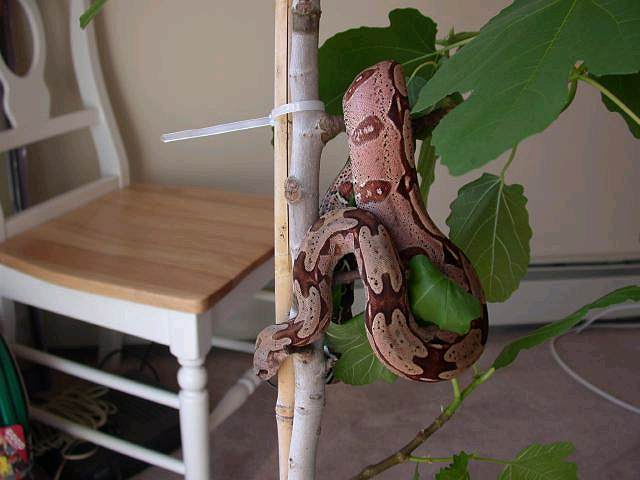 This being is the living evidence for the fact, that it is impossible to tell a true Boa constrictor subspecies from a crossbreed only from its appearence. The animal looks like a true Boa c. constrictor from the distribution area Surinam, but the father was a Colombian Boa c. imperator!
You see what we will face in the future and maybe you understand why we use almost exclusively wildcaught and farm bred animals for our breeding projects. We thank Tom Burke for providing us with this photo. He has not bred this animal, he just bought it.
He don't shares our attitude completely, either.
Breeding Crossbreeds
By now, most people who seriously deal with the topic “boids” have encountered the issue involving hybridization and integration. This has since lead to enthusiasts - especially those of Boa constrictor - placing strong emphasis on acquiring pure-bred animals.
As a result, it is becoming increasingly difficult to sell crossbred boas, as the demand for such animals is decreasing.
For instance, if you acquire a pair of crossbred Boa constrictor for the purpose of propagation, you must consider the possibility of being unable to sell the offspring later on. Many breeders in that situation then turn to pet stores. For that reason, you cannot be certain that they will take your animals even there. Crossbred boas pretty much fetch the lowest sales price of all boas and pythons anyways.
You may now ask yourself why we are talking about money. Very simple: As consulting authorities for the district councils in Bavaria, we are regularly consulted for inventory and facility evaluations. In our experience, it is ALWAYS the “cheap snakes” (please excuse this terminology; it is not regarding the quality, but the monetary value of the animal) that are kept in the worst of conditions. The majority of these snakes were purchased at pet stores for relatively little money. Because of the low purchase price, the buyer does not put a lot of considerations into the needs of the animals, going by the motto: “If that thing dies, there won’t be much money lost”.
We are by no means saying that all keepers of inexpensive boas and pythons keep their animals in bad conditions. It is simply a fact that all those poor creatures without a suitable enclosure, whose keeper had never even purchased a book to familiarize himself/herself with its husbandry requirements, were all “cheap snakes” (e.g. crossbred boas, ball pythons, Burmese pythons).
Therefore, if you give a litter of crossbred animals to a pet store, you can be certain that some of these poor creatures will not survive their first year of life due to the insufficient care by their future keeper. Would you like that? Again, the following sentence applies: “The responsibility of the breeder is often underestimated.”
Recognize a crossbreed Boa constrictor | Boa constrictor mutts | distinguish a crossbreed Boa constrictor | how to tell a crossbreed boa from a true boa constrictor | Boa constrictor cross | Boa constrictor mix-breed | cross-breeding boa constrictors
You should NEVER breed a true Boa constrictor to a crossbreed Boa constrictor!
You may now say that you don’t even want to breed your animals, but rather just keep one single specimen. Be assured: Very few of the keepers, who later produce offspring, had planned on doing so from the start. We therefore recommend for you to consider this, even when purchasing a single animal only.
 But even we own some crossbreeds...
. . . this email correspondence shows how things are going. We thank Daniel Nägele (www.dn-reptiles.de) for putting these lines to our disposal:
----- Original Message -----
From: Nägele
To: webmaster@boa-constrictors.com
Sent: Thursday, January 29, 2009 11:50 AM
Subject: Fw: surinam male
Hello Stöckl family
enclosed a fancy example...
I WROTE HIM BECAUSE OF HIS TRUE SURINAME-MALE AND THIS IS HOW IT ENDED :-)
Maybe you can use the emails for your website or so...
regards and have a nice day, Daniel
----- Original Message -----
From: xxxxxxxx
Sent: Wednesday, January 28, 2009 7:12 PM
Subject: RE: suriname male
Hi Daniel,
thank you for your interest. The boa is from Germany and is cb 2006.
Enclosed some pics
regards xxxxxx
From: d.naegele@gmx.net
To: xxxxxxxxx
Subject: Re: surinam male
Date: Wed, 28 Jan 2009 23:26:43 +0100
Hello,
thank you for the photos...
Who is the breeder? In true boas it is quite a matter...
Looks a little emaciated, the little one, how big is it and what's the weight? What's the price?
Thank you and greetings Daniel
----- Original Message -----
From: xxxxx
Sent: Thursday, January 29, 2009 8:39 AM
Subject: RE: surinam male
Hi Daniel,
unfortunately I don't know the breeder. I have bought the animal from an elderly man who didn't knew either.
But from the markings one can recognize that it is a true boa.
It is about 1,30cm in length, it only looks small in the photo. Unfortunately I don't know the weight.
I have retrieved the animal from brumation about a week ago, therefore it has lost a little fat ;-).
Since it is a good feeder it should not be a problem.
The price is 400 Euro.
regards
Xxxxxxxxxx
From: d.naegele@gmx.net
To: xxxxxx
Subject: Re: surinam ´male
Date: Thu, 29 Jan 2009 11:02:14 +0100
Hi,
unfortunately this is too delicate and risky for me.
One can NEVER decide such a matter from the appearence of a boa!
Please read the interesting report at http://www.boa-constrictors.com on the CROSSBREEDS page...
I ask you to refrain from going on offering this animal as true Boa c.c. Suriname, because when someone performs a scale or saddle count he might prove that it is not a true boa c. c. and you could get in mighty trouble...
Without proof it is a gross negligence to sell such an animal.
You may want to look up my website www.dn-reptiles.de and learn that because of many people act this way crossbreeds who resemble true boas are put on the market.
regards and have a nice day, Daniel
-------------------------------------------------------------------------------
---- Original Message -----
From: xxxxxxxx
Sent: Thursday, January 29, 2009 11:25 AM
Subject: RE: surinam male
Hi,
I am sorry but I am VERY sure that it is a Boa c. c. Suriname. Therefore I will carry on offering it this way.
Unfortunately one can't recognize everything in the photos......
greetings
Our summary:
the breeder of the boas is unknown
the provenance of the boa is unknown (except that it is from Germany *head-shaking*)
the parents are unknown
but the owner is VERY positive, that the boa is a Boa c. constrictor from Suriname. Therefore he will carry on offering this animal this way.
We are sure that he will finally find someone who buys it (unfortunately this happens every day). We are time and again astonished as to the naivety of the people who buy such "true" boas. Therefore our hat is off to Mr. Nägele, who wasn't satisfied by such a "blah- blah".
Another case:
Sandra Heeg didn't question the claim of the pet-shop owner that the boa in the photo below is a "Boa c. orophias". She credulously bought the animal
These kind of reptile dealers prey on the inexperience and gullibility of their customers.
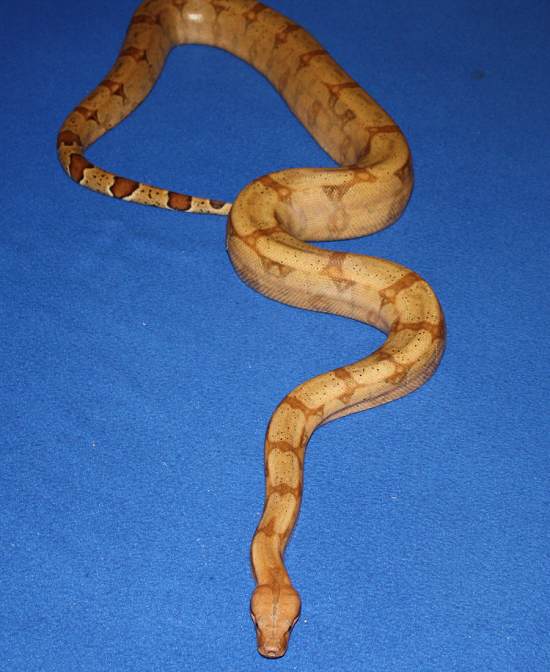 Crossbreed, probably a cross between a Hog Island Boa and a crossbred boa with Colombian ancestors; sold as "Boa c. orphias"
photo: Sandra Heeg
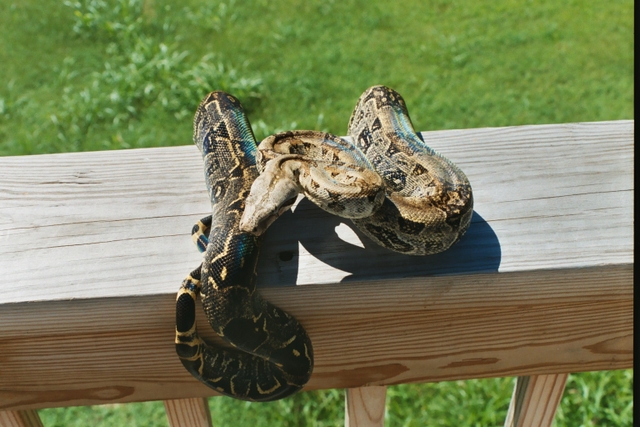 For comparison:
Boa c. orophias a "real one" :o)
photo: Jeff Murray
The notion that a true Boa c. orophias would end up being sold in a pet shop is downright riduculous due to the scarcity of these animals. In this matter, the salesman in the pet shop brazenly took advantage of the inexperience of Mrs. Heer.
Unfortunately we are not talking about isolated cases, but (almost) about standard ...